
Ontario Landlord Tenant Act Rent Rules: How Windsor owners can raise rent legally and protect ROI
Owning a rental property is supposed to feel like an investment, not a constant compliance quiz. But Ontario Landlord Tenant Act rent rules are strict on notice, timing, and documentation, and small mistakes can create big problems: delayed increases, tenant disputes, and avoidable Landlord and Tenant Board exposure.
This owner-focused guide breaks down how rent increases work, what “rent control” really changes, and how to keep your file clean. If you want the simplest path, Richmond Property Management can handle the entire workflow, from pricing strategy to compliant notices; so you stay profitable without living in spreadsheets and forms.
Set rent like a business decision, not a guess
Before you ever think about an increase, your best protection is a starting rent price you can defend. A strong pricing approach reduces vacancy, attracts better applicants, and minimizes the “negotiation energy” that often leads to informal agreements that don’t hold up later.
A practical owner pricing file should include:
True comparable rentals (same area, similar condition, similar utilities)
A feature list that affects demand (parking, laundry, yard, upgrades)
A realistic vacancy target and leasing timeline
Your ideal tenant profile (who this unit is best for)
Richmond’s approach is to price with real market logic and a leasing plan, because “high rent” is useless if the unit sits.
The rent increase basics owners must follow
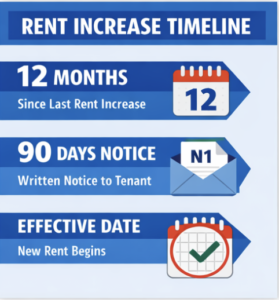
For most rentals, rent increases are governed by process. The Landlord and Tenant Board’s materials emphasize two owner rules that matter every time:
Timing: rent can generally be increased only after at least 12 months have passed since the last increase (or since a new tenant moved in). Tribunal Ontario
Notice: landlords must provide at least 90 days’ written notice using the proper notice form. Tribunal Ontario
This is where many self-managing owners slip, especially when the unit is doing well and they try to “tighten things up” via text or casual email. Rent increases should be treated like a compliance workflow, not a conversation.
Rent control vs exempt units: why status changes your strategy
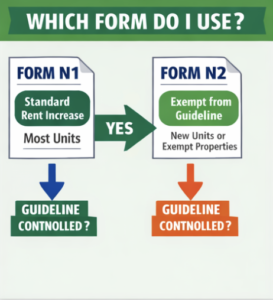
Not every unit is treated the same. If a rental unit was not occupied for residential purposes on or before a specific cutoff, it may be exempt from the rent increase guideline. In those cases, the landlord still must provide written notice using the proper form, but there is no limit on the size of the rent increase. Tribunal Ontario
This is a big deal for owners with newer units, additions, or newly created suites. The risk isn’t just “how much can I raise?” It’s getting the unit status wrong and issuing the wrong notice or assuming the guideline applies when it doesn’t (or vice versa). Richmond confirms unit status first, then builds the rent plan around what’s legally permitted.
The current guideline: plan the math, then plan the message
The Province sets a rent increase guideline that caps how much most landlords can increase rent without applying for approval. The current guideline is 2.1%. York Region
Owner tip: don’t think of the guideline as “permission to increase.” Think of it as one piece of the retention puzzle:
If you’re under-market, a small increase may still leave you under-market
If you’re at the top of the market, pushing the full guideline may increase turnover risk
If you want long-term tenants, communication and timing matter as much as the percentage
Richmond typically positions increases with clear, calm communication and proper documentation, so tenants understand it’s procedural—not personal.
What form do you use for a rent increase?
The Landlord and Tenant Board provides specific rent increase notices, including Form N1 (common rent increase notice) and Form N2 (used for certain exempt situations). The LTB’s form page lists both options and makes it easy to choose the correct notice. Tribunal Ontario
If you take nothing else from this post: use the proper notice, deliver it properly, and keep proof in your file.
A simple compliance checklist for owners
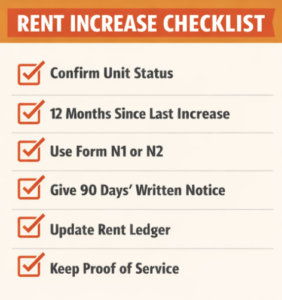
Use this as a quick “owner sanity check” before you increase rent under the Ontario Landlord Tenant Act rent rules:
Confirm whether the unit is guideline-controlled or potentially exempt Tribunal Ontario
Confirm at least 12 months have passed since the last increase Tribunal Ontario
Use the proper notice form (N1 or N2) Tribunal Ontario
Provide at least 90 days’ written notice Tribunal Ontario
Update your rent ledger and keep service records, communications, and proof of delivery
Lorem ipsum dolor sit amet, consectetur adipiscing elit. Ut elit tellus, luctus nec ullamcorper mattis, pulvinar dapibus leo.
Why Richmond is the best alternative to self-managing rent increases
Most owners don’t struggle because they’re careless—they struggle because they’re busy. Richmond Property Management is built to be the hassle-free ownership option: we run rent as a documented system, not a last-minute task.
With Richmond, you get:
Market-based pricing and leasing strategy
Proper forms, timelines, and documentation
Consistent tenant communication that reduces conflict
A professional file that’s ready if a dispute ever arises
If you want rent increases handled correctly, without stress, missed steps, or tenant friction, work with Richmond Property Management.
Visit Richmond’s website and request an owner consultation to review your rent strategy and compliance workflow.